


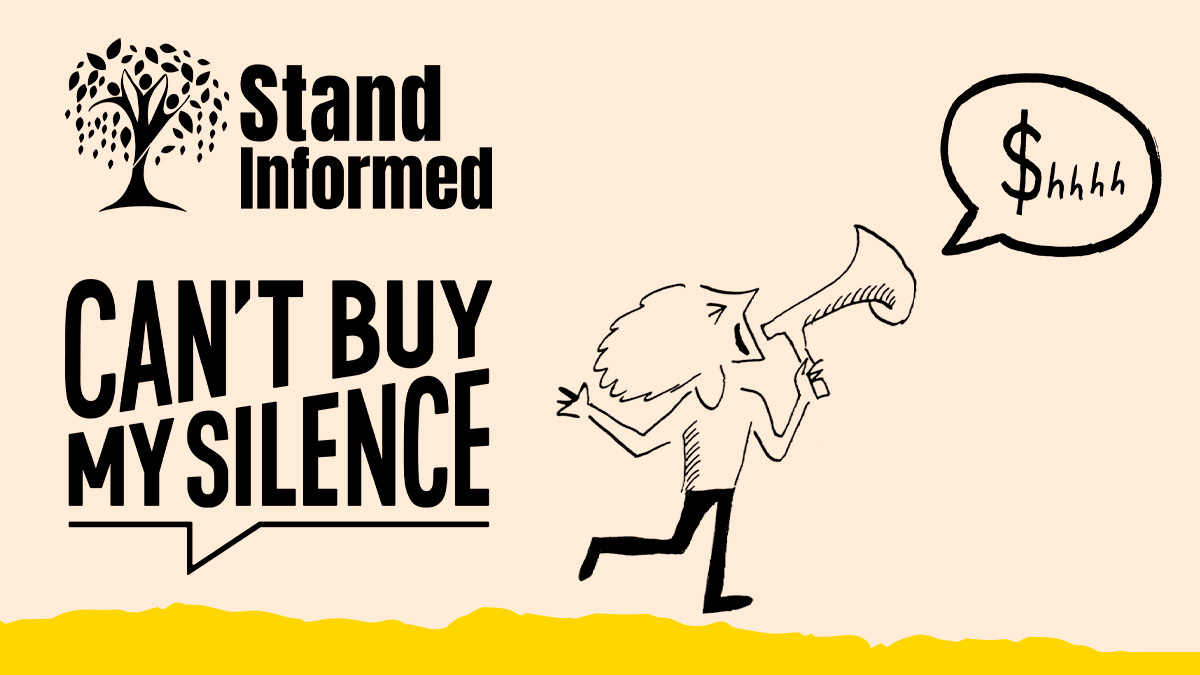
A Global Campaign to end the Misuse of Non-Disclosure Agreements to Buy Survivor Silence
The #MeToo Movement brought attention to sexual harassment and sexual misconduct including harassers like Harvey Weinstein who have repeatedly harmed individuals. It also started a discussion about the use of non-disclosure agreements (NDAs) in settlements preventing the complainant from being able to speak about what happened. NDAs protect the employer and the harasser by silencing the complainant. With #MeToo, some women, like Zelda Perkins, chose to break their NDAs and speak out. There is now a global campaign to bring awareness to the harms caused by NDAs and lobby to ban their use.
Learn more about the campaign at cantbuymysilence.com
What’s the problem?
You may wonder, what is the harm if the complainant signs an NDA as part of the settlement? Signing an NDA means you can’t talk about what happened; this often means you can never speak to anyone (including family and mental health professionals) about what happened.
NDAs:
- May prevent a complainant from speaking to family and friends about their own experiences;
- May prevent someone from getting counselling support needed to deal with the trauma of the sexual harassment;
- Prevents a complainant from warning others about the harasser;
- Protects the employer’s reputation and the career of the harasser;
- Allows the harasser to stay in their position, or move to another workplace without revealing any information about the harm they have caused;
- May put the complainant, and sometimes their coworkers, in awkward positions when they can’t speak about what happened: can’t explain problems at work or reasons for leaving;
- Have a chilling effect on anyone who wants to speak up about wrongdoing; and
- Cause people who sign NDAs to live in fear of accidentally breaking the agreement.
People are often pressured to sign NDAs, and may not understand they can refuse or negotiate something different. Sometimes people think that they will never want to talk about what happened and sign an NDA, but years later, find that they cannot heal because they haven’t been able to talk about and process what happened. Blanket NDAs are not necessary to protect a complainant’s identity, yet they are damaging to innocent parties, and hide harmful information from the public.
What’s Happening
With increasing recognition of the problems with NDAs in sexual harassment and sexual misconduct cases, many places are passing laws restricting the use of NDAs. In the United States, legislation in more than 29 US states (including: California, Washington, Oregon, New York), and 2 federal acts restrict NDAs. In 2023, the United Kingdom passed a law restricting NDAs in higher education. In 2025, another law was passed restricting NDAs in the employment context. In 2025, Ireland also passed a law limiting the use of NDAs as did the state of Victoria, Australia
In Canada, in 2021, Prince Edward Island became the first to province to pass legislation limiting the use of NDAs in harassment and discrimination situations. In 2022, Ontario passed legislation restricting NDAs in the post- secondary education and real estate contexts. Manitoba, BC, Ontario, Saskatchewan, Quebec, and Nova Scotia and the Federal government have all previously considered similar legislation concerning NDAs, but the bills were not passed before the legislatures were dissolved.
The Uniform Law Conference of Canada (ULCC), which makes recommendations for the harmonization and reform of laws in Canada, established a Working Group on NDAs in 2023. CLAS Lawyer, Jennifer Khor, is chair of the Working Group. The Working Group has delivered 3 policy papers (2023; 2024; 2025 – 2025 Français). They are now developing uniform model legislation that will be brought to the ULCC in August 2026.
CLAS wants to raise awareness about the problems with NDAs and encourage discussion about restricting the use of NDAs in sexual harassment and sexual misconduct cases in British Columbia. We need your help to show people in BC are concerned about this issue.
How You Can Participate
Speak Out: Ending Gender-Based Violence is a community consultation project by CLAS. We heard from people who face the risk of gender-based violence (GBV), and those who may be asked to sign a non-disclosure agreement (NDA). CLAS engaged with communities to develop recommendations for law and policy reform to support people in reporting GBV, and to regulate NDAs. Recommendations were informed by community, culturally sensitive, and provide for the needs of people most at risk of GBV. We seek to empower communities to speak out and to ensure their safety.
We want to support future generations in reporting GBV.
Share Your Experience (Global Experience Survey)
Because NDAs silence survivors of sexual harassment, it is difficult to collect information on the problems NDAs can cause. If you have experienced sexual harassment in the workplace, we invite you to anonymously share your story. The questions are designed to collect information on the experience of bullying and harassment, including sexual harassment, and how often NDAs are used. You will not be asked to identify yourself or your workplace. The information you share will help us to better understand the issues when NDAs are used and raise awareness about the impact.
Learn more about Can’t Buy My Silence’s data partner Speak Out Revolution: https://www.speakoutrevolution.co.uk
You can see the insights from the stories collected so far on the Speak Out Revolution Dashboard below. (Click here to view the below dashboard fullscreen.)