


Should the government have the ability to override fundamental rights?
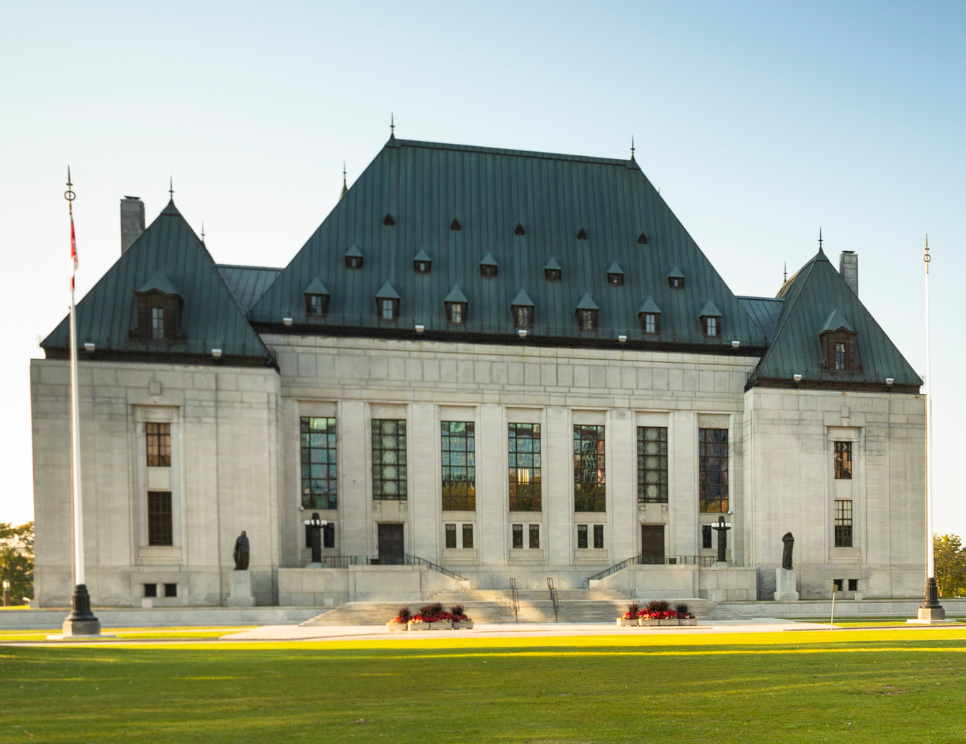
That’s the question sitting at the centre of a major case now before the Supreme Court of Canada: English Montreal School Board v. Quebec (Bill 21).
This case will not only determine the future of Quebec’s secularism law, but also how courts approach the use of the notwithstanding clause, which is a constitutional provision that allows governments to override certain Charter rights.
The Community Legal Assistance Society (CLAS) participated in this case as an intervener. CLAS was represented by counsel Jonathan Blair and Danielle Sabelli.
What is Bill 21?
Quebec’s Bill 21 restricts certain public sector workers, including teachers and other government employees, from wearing religious symbols while performing their roles.
The law was enacted using section 33 of the Canadian Charter of Rights and Freedoms, commonly known as the notwithstanding clause, which allows governments to pass laws that operate “notwithstanding” certain Charter protections, for renewable five-year periods.
Why this case matters
This case is not only about one law in Quebec. It raises broader constitutional questions, including:
- What role do courts play when governments invoke the notwithstanding clause?
- Are there limits to how that power can be used?
- How should fundamental rights be understood within Canada’s constitutional framework?
Can governments use the notwithstanding clause to enact discriminatory laws? The answers to these questions will have implications across Canada.
The role of public interest groups
While public interest groups, like CLAS, are not parties to the case, courts can grant them permission to intervene when they can provide useful legal perspectives.
As an intervener, CLAS made legal submissions to assist the Court in understanding the broader constitutional context and implications.
CLAS’s Intervention
In oral argument before the Supreme Court of Canada, counsel for CLAS, Jonathan Blair, grounded the issues in this case in Canada’s constitutional history. He emphasized that this is not just a theoretical concern. If the notwithstanding clause is used to protect discriminatory laws from being reviewed, it can lead to serious rights violations.
As he explained, this is not a hypothetical risk, but one reflected in historical experience: “It is fundamentally the history of our Constitution.”
He pointed to the role that discriminatory laws have played in past harms, noting that: “many of the atrocities of the 20th century are the result of discriminatory legislation.”
These submissions situate the case within a broader constitutional context, in which modern rights protections, including those in the Canadian Charter of Rights and Freedoms, developed, in part, in response to that history.
From this perspective, CLAS argued that non-discrimination is a foundational principle of Canada’s constitutional framework. Although it is not explicitly set out in the text of the Constitution, it underlies the system as a whole and reflects the inherent worth and dignity of all individuals.
CLAS further argued that this principle is so fundamental that, in appropriate cases, it may limit the use of the notwithstanding clause. In other words, legislation that is fundamentally discriminatory may still raise constitutional concerns, even where a government has invoked section 33.
CLAS’s submissions focused on the implications of interpreting the notwithstanding clause in a purely textual and isolated way. As counsel explained, its invocation may create situations where legislation: “could be fundamentally inconsistent with constitutional architecture and yet not breach a written principle of the text.”
In this way, treating the clause as placing legislation entirely beyond constitutional scrutiny risks undermining the broader structure and principles of the Constitution, including the foundational principle of non-discrimination.
Ultimately, CLAS framed the case as turning on a basic question: what is the role of the Court when the notwithstanding clause is invoked? Does the Court continue to have a constitutional role to play, or does the legislature have the final word? Given the Court’s role as a guardian of the Constitution, counsel emphasized the importance of constitutional safeguards:
“None of us can know for sure what the future holds, but we must not repeat the historical mistakes we have made.”