


By Tina Daschuk, SHARP Workplaces
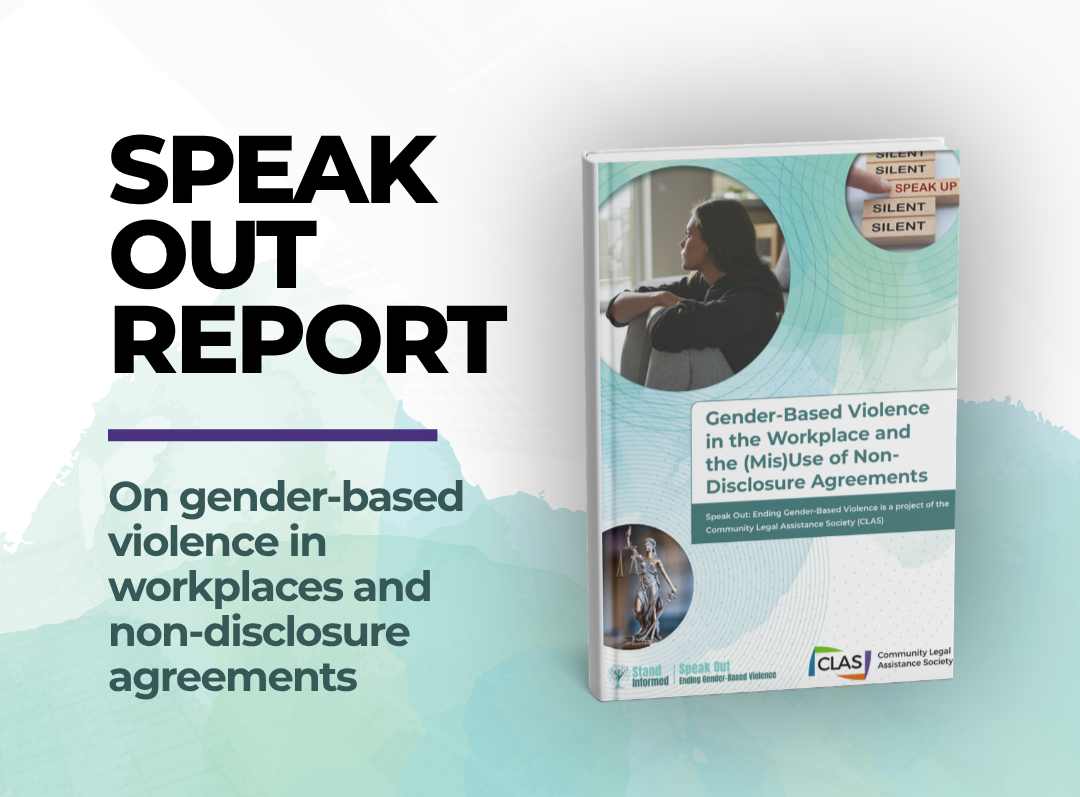
Community Legal Assistance Society’s newest report is Gender-Based Violence in the Workplace and (Mis)Use of Non-Disclosure Agreements. The report looks at the growing problem of workers experiencing gender-based violence (GBV) at work. It explores how non-disclosure agreements (NDAs) are being used against workers by their employers. Rather than protecting workers who experience GBV, employers are adding to GBV in the workplace by avoiding accountability and pressuring workers to sign NDAs to stay silent about what happened to them.
What is gender-based violence?
Gender-based violence (GBV) is violent action against someone. It is violence based on gender, gender expression, or their gender identity. The actions can be physical, verbal, mental, or emotional. It can be committed by any gender against any gender. However, it is most commonly done by cis-male individuals against women and 2SLGBTQIA+ individuals (97% of people accused of sexual assault in Canada are male ¹). GBV includes sexual assault, harassment, discrimination and intimate partner violence.
Gender-based violence in the workplace
While GBV can happen in our private lives, it also happens in the workplace. Laws require employers to have policies and practices to provide workers with a safe workplace. Yet, GBV is still happening on jobsites across BC. Workplace sexual harassment is a type of GBV and can look like:
- Unwanted sexual comments, invitations, and “jokes”,
- Showing or sending sexually suggestive material,
- Unwanted physical touch,
- Stalking, or
- Sending or taking non-consensual intimate images.
Even when GBV is reported, employers may fail to address the situation or take a trauma-informed approach. Participants in our survey who experienced GBV at work shared that their employer’s policies were not helpful and resulted in more harm. Some issues they shared are:
- Retaliation: Workers who reported GBV experienced punishment such as being fired or forced to quit, exclusion at work, or damage to their reputation.
- Victim-blaming: Workers were accused of lying about GBV or misunderstanding what happened.
- Lack of or weak accountability: Perpetrators faced no or very few consequences for engaging in GBV.
- Power imbalances: Workers felt powerless, especially when GBV involved a supervisor, management or someone in a leadership role at work.
- Enabling environments: The workplace was toxic, had a culture of silence, high employee turnover rates, and leadership bias. Leadership prioritized protecting reputation over safety.
- Lack of training: Employees were given no bystander and prevention training, or it was insufficient.
- Implementation failure: Work policies were not applied consistently or not complainant-focused. Complainants shared being frustrated about not being told about timelines and updates. There was no trauma-informed approach used during the complaint process.
- Leadership issues: Lack of communication from leadership about the complaint.
- Intersectionality discrimination: Racialized workers who experienced GBV also dealt with racial bias and a lack of cultural competency from leadership.
How are non-disclosure agreements involved in workplace GBV?
Non-disclosure agreements (NDAs) are agreements that restrict what information can be shared with other people or organizations. They usually have no end date. When GBV happens at work, employers have used NDAs to stop workers from sharing their experience with others. Workers have been pressured to sign NDAs before a workplace investigation is started or when they settle the issue with their employer.
Employers are legally required to protect a worker’s privacy and keep information confidential, including during workplace investigations. However, NDAs go beyond those obligations by restricting workers from discussing their own experiences of GBV. By signing an NDA, workers are prevented from speaking about their experience with anyone. This includes close family members, friends, future employers and health professionals. Without a clause that specifies how long the person must stay silent, workers who sign NDAs cannot speak about their experience for the rest of their lives. Employers use NDAs to protect themselves and perpetrators from reputational harm and accountability for GBV.
What happens to workers after they sign an NDA?
Workers may be facing financial pressure and wanting to avoid long, triggering legal processes. Therefore, workers may feel they have no other choice but to sign an NDA.
In our report, participants talked about how signing an NDA had several negative impacts. Workers who sign NDAs may experience depression, anxiety, trauma and lowered self-esteem because they cannot speak about what has happened to them. Within the workplace, relationships are damaged because workers cannot speak freely and are unable to warn others. Workers are also prevented from explaining why they had to leave to others, especially future employers.
What should be done to address GBV in the workplace?
Governments, employers, workplace safety regulators like WorkSafe BC and the legal community all have an important role to play in addressing GBV in the workplace and preventing harm caused by the misuse of NDAs. Our key recommendations are directed at:
- The BC government: to create new laws that ban, limit and regulate the use of NDAs in GBV cases.
- WorkSafeBC: to require employers to have policies and procedures to address GBV. To require employers to adopt additional regulations to ensure GBV incidents are reported to joint health and safety committees.
- Employers, employee organizations, unions and professional associations: to oppose or stop using NDAs in situations of GBV. To provide training on GBV in the workplace. To develop stronger policies and procedures that are informed by people with lived experience of GBV. To take a complainant-focused approach, and establish organizational values and commitments to equity, diversity, including, and safety. Organizational leaders to set expectations and act to address GBV.
- The legal community: to work to understand the impacts of GBV and take a trauma-informed approach in working with clients. To oppose or limit the use of NDAs in GBV-related cases, and consider ethical guidelines on the use of NDAs.
To see the full list of recommendations, please read our Speak Out Report.
Where can workers experiencing GBV get help?
GBV continues to be an ongoing problem in workplaces across BC. The trauma and negative impacts go beyond the GBV incident itself. Many employers continue the harm of GBV by not taking accountability, not making meaningful changes, and by silencing workers with NDAs.
It is important for workers to know their rights when experiencing GBV or when being pressured to sign an NDA. Contact us if you are experiencing sexual harassment at work, or if you are being asked to sign an NDA for workplace harassment. We may be able to help.
If you are interested in supporting our advocacy for change, please also reach out to us.
Email: [email protected]
Phone number: 604-673-3143 or toll-free: 1-888-685-6222.
SHARP Workplaces also provides free training and resources on workplace sexual harassment.
Sources
Julie S Lalonde, “Gender-based violence across Canada” (21 November 2023), online: Canadian Museum for Human Rights [https://humanrights.ca/story/gender-based-violence-across-canada].