



It is time to have a real conversation about what happens in Canadian workplaces. Unwanted “compliments” or sexual jokes happen often. Most of the time, the person responsible thinks it is not harassment because the other person did not complain. This is a common example of the many myths that allow workplace sexual harassment to continue. However, here is the reality: 2024 data shows that 47% of women and 31% of men reported experiencing harassment or sexual assault at work. To create safe and more respectful workplaces, we need to unlearn these myths.
What is workplace sexual harassment?
Workplace sexual harassment is any unwelcome conduct, either sexual or gender-based, that happens in an environment connected to work that negatively affects the workplace or the worker. It can be in verbal, physical, written, or online interactions.
A person does not have to actively object for the conduct to be “unwelcome.” Instead, the negative, work-related effects prove that the conduct was unwelcome. These effects include feeling uncomfortable or unsafe, losing work hours, or getting fired.
Sexual harassment is about abuse of power that includes actions, which may be physical or psychological, explicit, or subtle.
They can be:
- sexual comments, teasing, jokes, or compliments about appearance;
- sexual gestures;
- showing pornographic or sexually suggestive material in person or online;
- unwanted physical contact;
- repeatedly asking someone out after they have said no;
- comments about a person’s gender identity or expression; or
- microaggressions
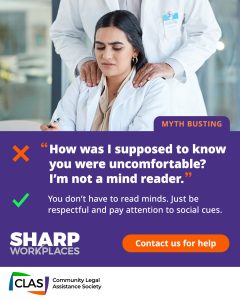
Many people who experience workplace sexual harassment do not report it for different reasons. They may feel shame, self-blame, fear of job loss, fear of not being believed, being labelled a troublemaker, retaliation, damaging their career, and/or fear for their physical safety. Another reason people do not report is because of myths and misconceptions about consent, and “appropriate” response to sexual advances. These wrong ideas cause harm.
Myth vs Truth: Why myths are dangerous
Myths around sexual harassment spread and continue harmful stereotypes. Myths add to the underreporting of and misinformation about sexual harassment, creating a culture where these harmful actions go unchecked.
Canadian courts are rejecting gender-based myths and stereotypes in sexual harassment and assault cases. The BC Human Rights Tribunal (BCHRT) has rejected the requirement that a complainant of sexual harassment actively show that the conduct was unwelcome, as this leads to gender-based myths and stereotypes. The Supreme Court of Canada also noted that myths and stereotypes in sexual violence cases against women can cause real harm. The court has said it should not be assumed that someone agrees to something if they do not say ‘no’. Consent for sexual acts must be expressly and actively given.
We’re now going to debunk some common myths about workplace sexual harassment:
Myth 1: “It was just a joke, everyone laughed; it is not sexual harassment.”
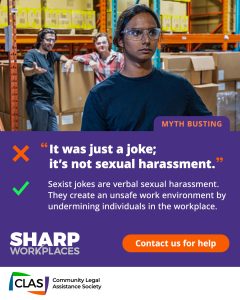
Truth: When “jokes” are sexual, sexist or target gender identity, they are workplace sexual harassment. These “jokes” are especially damaging when they come from leadership or management. They set an example for a culture where such disrespectful behaviour is seen as okay. Even if others do join in laughing, these comments encourage attitudes that have a negative impact on everyone in the workplace. The “jokes” and comments often become more explicit and may be personal attacks disguised as jokes.
Takeaway: Even if the person being harassed laughs, it does not mean it is accepted. People may laugh because they feel uncomfortable, or if the joke is from someone in leadership or management, they may feel pressure to join in. The intent of the harasser does not matter; what matters is how their conduct made someone feel.
Bystander tip: Calling out these kinds of “jokes” when they happen, if safe, is often the best way to stop the behaviour.
Laughing along or staying silent can signal that sexist jokes are acceptable. It is not just a joke; it is harassment.
Myth 2: “If they did not object or react, then the conduct is welcome.”
Truth: A person does not need to expressly object for conduct to be ‘unwelcome.’ Forcing someone experiencing sexual harassment to prove a behaviour was unwelcome places the focus on them rather than on the wrongful behaviour of the harasser. This leads to the unfair stereotype that if a person is silent, they are ok with the behaviour. It forces the person being targeted to have to prove they did not want the conduct, and can lead to people doubting their story. The focus should be on the negative impact caused by the conduct.
Takeaway: “silence does not mean consent.” People react to harassment in different ways. They may speak up, freeze, laugh, go quiet, or change the subject. Often, because of power dynamics in the workplace, people fear that speaking out will result in losing their jobs, getting demoted or being labelled a troublemaker or unfriendly.
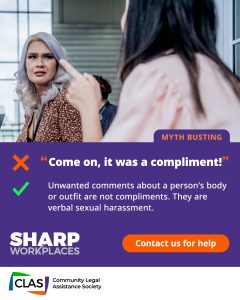
Myth 3: “It was a compliment! I was just being nice.”
Truth: Friendly compliments about a person’s work can show appreciation and create a positive environment. However, compliments become sexual harassment when they are sexual in nature, target a person’s gender and negatively impact the work environment or individual.
Takeaway: To create a respectful workplace, compliment skills, performance, and results, not appearance. For instance:
- Good: “Excellent job on the presentation, it was well researched.”
- Avoid: “You looked amazing during the presentation, it seems the shorter the dress, the more we concentrate.”
Comments about a person’s body or outfit are not compliments but may be sexual harassment.
Myth 4: “If they dress attractively, they are seeking attention.”
Truth: What someone wears is never an invitation for unwanted attention. Blaming a person’s choice of outfit is shifting the blame from the harasser to the person being harassed. Also, remarks that a person’s appearance is the reason for their career success, such as promotion, are harmful stereotypes to the worker. Unwanted attention constitutes workplace sexual harassment.
Takeaway: A person’s appearance is not an invitation for your attention, nor is it responsible for their career success.
Myth 5: “If I keep asking, they will eventually say yes.”
Truth: When someone says no, believe them. Saying no does not mean a person is playing hard to get.” Repeated, unwanted invitations to go on dates or other invitations can create an unsafe environment where one feels pressured to respond positively. This is workplace sexual harassment.
Takeaway: No is a complete sentence, respect it. Continuing to push someone after they have declined an invitation can constitute workplace sexual harassment.
Myth 6: “Most reports of workplace sexual harassment are just made up.”
Truth: False reports are actually very rare. The real problem is that many workplace sexual harassment incidents go unreported. This is due to several reasons, including fear of job loss or fear of not being believed.
Takeaway: There are many incidents of workplace sexual harassment that go unreported for many reasons. We should create a culture where people feel safe to speak up without fear.
Myth 7: “Women want men to dominate or take control by showing romantic interest.”
Truth: Workplace sexual harassment is not about romance; it is an abuse of power. An attempt to pursue a person
aggressively or ‘dominate’ them is bullying and can be considered workplace sexual harassment.
Takeaway: Sexual harassment is about abuse of power, not romantic interest.
Myth 8: “It is only workplace sexual harassment if it happens at the office.”
Truth: Workplace is any place or activity related to work. It is not limited to a physical location or work hours.
Takeaway: Workplace sexual harassment can occur in the office, work from home, work parties, business trips or interactions over social media.
Conclusion
Myths about workplace sexual harassment cause harm. While we may come from different backgrounds and cultures, one thing remains clear for everyone: respect. We must be respectful in our workplace interactions, pay attention to social cues, and ask questions when unclear or unsure. Employers, particularly, have the responsibility to debunk these myths and to set the right atmosphere by having a clear workplace policy and training all workers on workplace sexual harassment.
If you or someone you know is experiencing workplace sexual harassment, contact us to find out how we can help.
Email: [email protected]
Phone number: 604-673-3143 or toll-free: 1-888-685-6222.
SHARP Workplaces also provides free training and resources to prevent and respond to sexual harassment.
Sources
Statistics Canada, Gender Results Framework: A New Data Table on Workplace Harassment, 2024, Catalogue no. 11-001-X (2024); Statistics Canada, Workers’ Experiences of Inappropriate Sexualized Behaviours, Sexual Assault and Gender-based Discrimination in the Canadian Provinces,2020, Catalogue No. 85-002-X (2021).
Janzen v. Platy Enterprises, [1989] 1 SCR 1252.
Al-Musawi v. One Globe Education Services, 2018 BCHRT 94 at para 30;Mahmoodi v. University of British Columbia, and Dutton, 1999 BCHRT 56 at paras 135-136.
Employment and Social Development Canada, Workplace Discrimination and Harassment in Federally Regulated Workplaces: Results from the 2022 Survey of Employees under Federal Jurisdiction https://www.canada.ca/en/employment-social-development/services/health-safety/reports/survey-results-discrimination-harassment.html
Statistics Canada, Workers’ Experiences of Inappropriate Sexualized Behaviours, Sexual Assault and Gender-based Discrimination in the Canadian provinces,2020, Catalogue No. 85-002-X (2021)
Canadian Union of Public Employees, Canadian Union of Public Employees, “Stop Workplace Sexual Violence: Barriers to Disclosure” (6 December 2018); https://cupe.ca/stop-workplace-sexual-violence-barriers-disclosure#:~:text=Some%20of%20the%20barriers%20to,Concerns%20about%20confidentiality%20and%20privacy
Bethany Hastie, “Workplace Sexual Harassment, and the ‘Unwelcome’ Requirement: An Analysis of BC Human Rights Tribunal Decisions from 2010 to 2016”, (2020) 63 Allard Research Commons.
Ms. K v. Deep Creek Store and another,2021 BCHRT 158 (CanLII) at paras 77-93.
R v. Barton, 2019 SCC 33 at para 1.
Bento v. Manito Rotisserie & Sandwich 2018HRTO 203 (CanLII) at para 108; Ms. K v. Deep Creek Store and another,2021 BCHRT 158 (CanLII) at para 93.
Government of Canada, “Sexual misconduct myths and facts” https://www.canada.ca/en/department-national-defence/services/benefits-military/conflict-misconduct/sexual-misconduct/training-educational-materials/myths-facts.html.
Taylor Bain, “There is no ‘hidden crisis’ of false sexual assault accusations,’ Canadian Lawyer,February 20, 2026; https://www.canadianlawyermag.com/news/opinion/there-is-no-hidden-crisis-of-false-sexual-assault-accusations/393748#:~:text=To%20be%20clear%2C%20false%20reporting,to%20discredit%20sexual%20assault%20complaints.